
A new client writes on Instagram
Before a manager notices the message later and copies it into NetHunt by hand.
After the message lands in NetHunt linked to the client record on its own.
 CRMUA
CRMUAThe CRM that lives inside Gmail: client folders, messages and mail stay connected without leaving your inbox
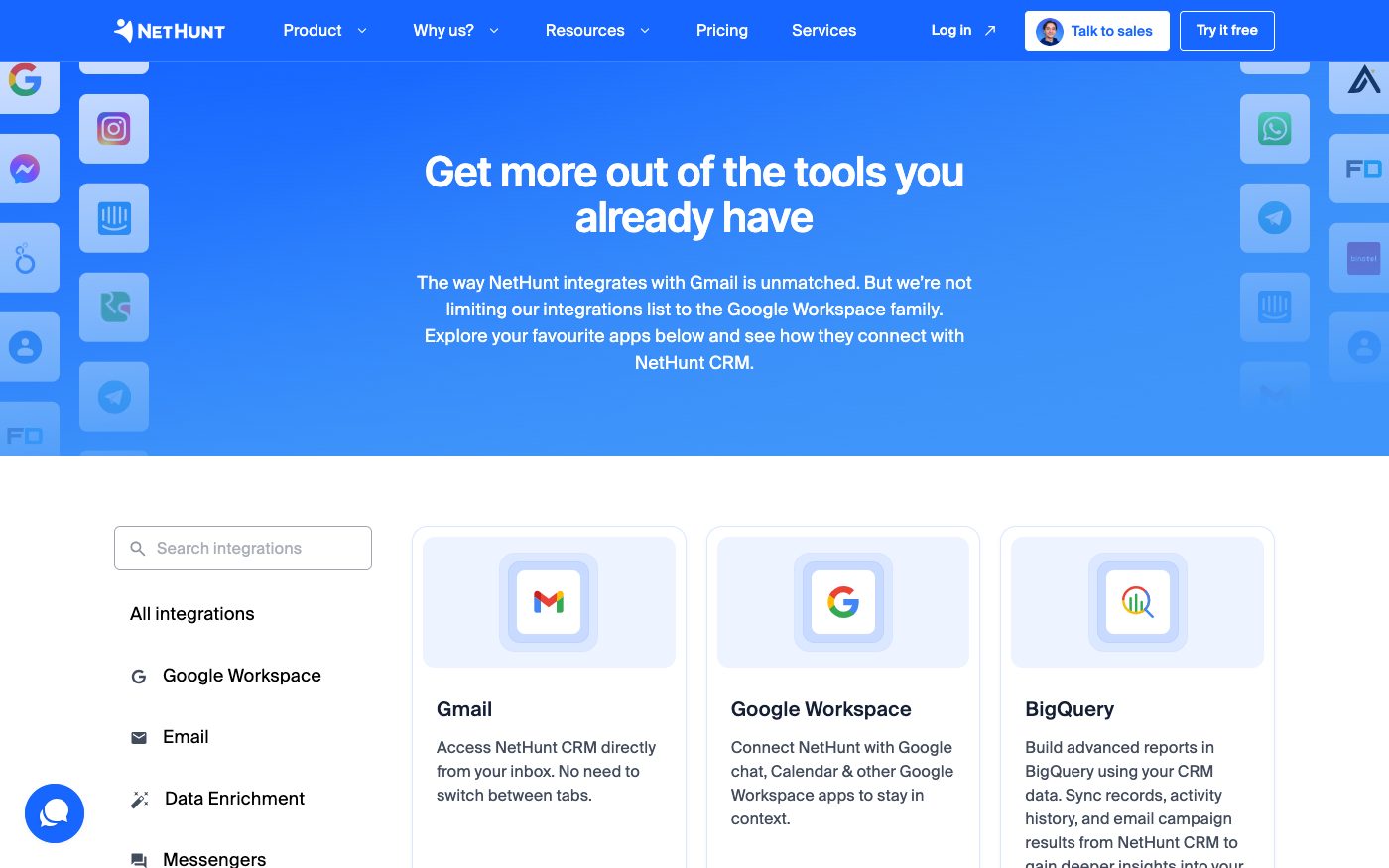
NetHunt is built directly inside Gmail, with client folders working like a pipeline instead of a separate app you have to open. It already connects to Gmail and the wider Google Workspace, to WhatsApp and Instagram messages, and to team chat in Slack, plus a wide range of other tools through a connecting service. We link NetHunt to whatever a ready connection doesn't cover, so a client record updates itself wherever it needs to, without anyone re-typing it.
Before a manager notices the message later and copies it into NetHunt by hand.
After the message lands in NetHunt linked to the client record on its own.
Before a manager forwards important emails into the CRM by hand, and some get missed.
After the Gmail thread stays attached to the client card automatically, so anyone who opens it sees the full history.
Before teammates in Slack find out about a client update only when someone remembers to mention it.
After the update can reach the team in Slack the moment the record changes.
Before someone exports records into a spreadsheet by hand and re-imports them elsewhere.
After a connecting service such as Zapier passes the update onward automatically instead.
For those who want to check: each point links to the official documentation page it comes from.
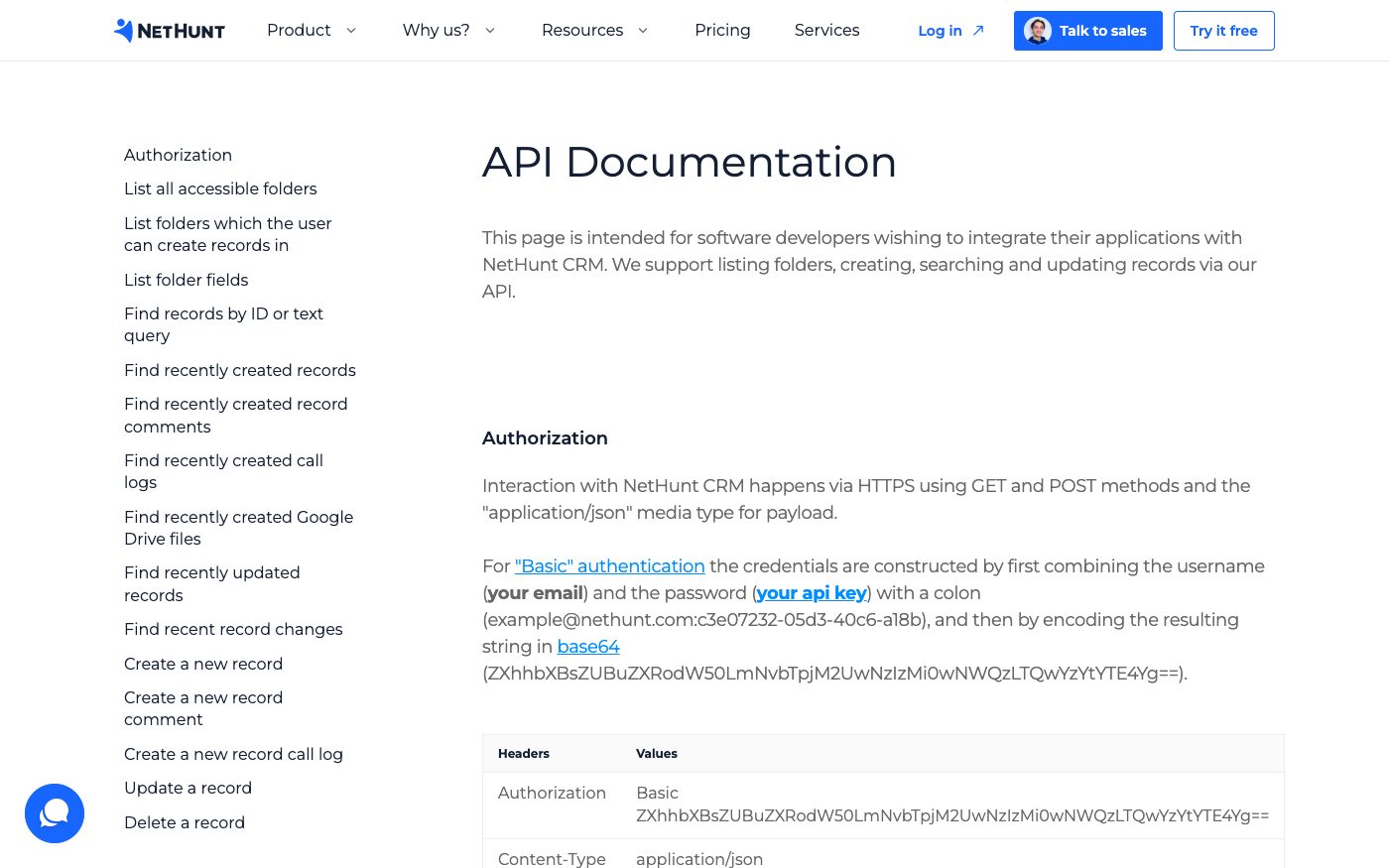
NetHunt publishes open API documentation for developers, officially supporting listing folders and creating, searching and updating records.
Source: nethunt.com ↗ checked 2026-09-25The interaction happens over HTTPS using GET and POST methods, with data sent as JSON.
Source: nethunt.com ↗ checked 2026-09-25Sign-in combines the account's email with a personal access key, both encoded together as Basic authentication.
Source: nethunt.com ↗ checked 2026-09-25One technical entry point lists every folder the signed-in user is allowed to see.
Source: nethunt.com ↗ checked 2026-09-25A separate entry point lists only the folders where the user is allowed to create records, not just view them.
Source: nethunt.com ↗ checked 2026-09-25NetHunt's open documentation doesn't list a daily number for how many technical requests an account can send — if a scenario turns out to be heavy, we check the real load with the vendor before relying on it.
Three steps from a first message to work on your project.
Describe the task in the form — in text or by voice. Budget and timing are optional.
A developer studies the brief, asks about anything unclear and sends an estimate.
Once scope and price are agreed, the work begins.
or write to info@coreviaflow.space
Describe the task in text or a voice message. We look at your setup and reply with a plan.
Four services people come to us for most often. Each page explains what we do, how the work goes and where to start.
Choose the system, set up the pipeline, migrate data, train the team.
Learn more →Accounting, telephony, website, payments and messengers feed the CRM on their own.
Learn more →Orders, requests and answers around the clock, straight into your CRM.
Learn more →Flows between CRM, email, spreadsheets, payments and AI, on your own server.
Learn more → CRMUA
CRMUAUkrainian CRM that pulls orders from your site, marketplaces and chat apps into one pipeline
See scenarios → CRMEU
CRMEUThe deal-focused CRM: connect it once, and deals, contacts and follow-ups keep themselves in sync
See scenarios → CRMUS
CRMUSUS CRM with built-in calling and no-code automation, ready to plug into the tools you already run
See scenarios → CRMUS
CRMUSUS CRM with a dedicated bulk data channel and a step-by-step process enforcer, built to plug into your existing tools
See scenarios → IP telephonyUA
IP telephony with ready-made CRM links and one-click calling
See scenarios → CRMUA
CRMUAThe CRM built for order-taking: every lead from every channel lands in one place on its own
See scenarios →Implementation · Development · Integrations →
NetHunt CRM is a trademark of its owner. CoreviaFlow is not affiliated with it unless stated otherwise. Screenshots are taken from public vendor materials; the source is shown under each one.