
CoreviaFlowCOREVIAFLOWDIGITAL PROJECT COMPANY Leave a request
EN UA RU
CAPABILITY

Marketplace Development

We design, build, launch and grow digital marketplaces.

From product architecture and seller infrastructure to launch, acquisition, automation and long-term growth.

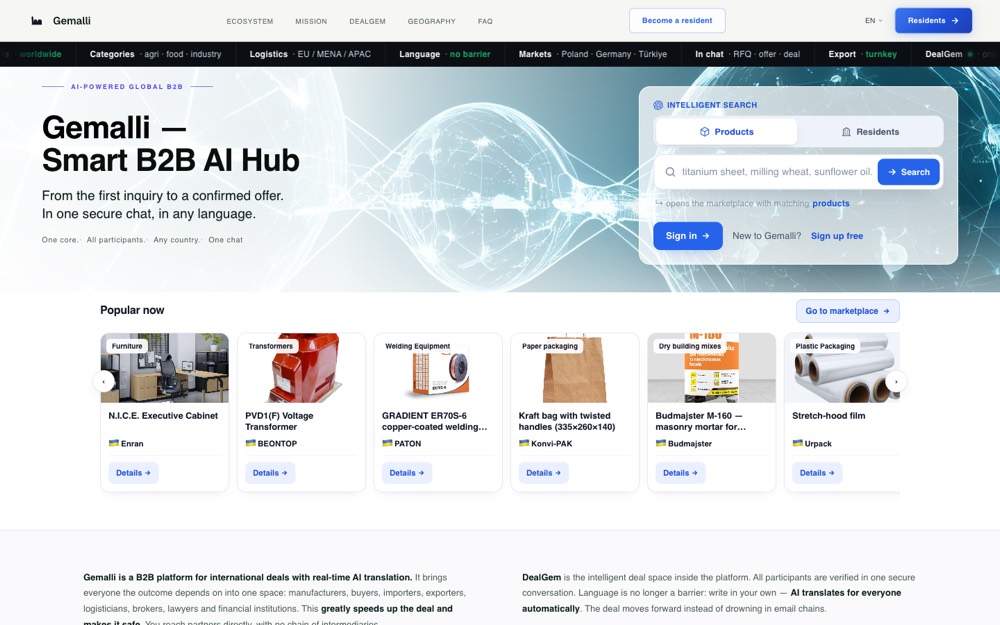
Gemalli — a platform built and operated by CoreviaFlow

What clients come to us with

01

You need your own marketplace, not a storefront on someone else’s.

02

You have the model but no team to build all of it: seller accounts, payments, CRM.

03

The marketplace is live, but search engines and AI assistants don’t find it — or it needs more languages.

01

Design

Business model, product architecture, user roles, permissions and the flows a deal actually goes through.

02

Build

Marketplace frontend, seller infrastructure, catalogue, dashboards, CRM, integrations and APIs.

03

Launch

Onboarding of the first sellers, content, testing, discovery setup and the operational routine around the platform.

04

Grow

Acquisition, analytics, automation and the changes that follow from what the data actually shows.

What we deliver

Product & business architecture

The marketplace model itself: roles, processes, permissions, money flow.

Seller and buyer infrastructure

Accounts, dashboards, catalogue management, enquiries and orders.

CRM, administration and analytics

The side the operator lives in: leads, moderation, reports.

Payments, integrations and infrastructure

Billing logic, external systems, deployment and monitoring.

01

Product & business architecture

The marketplace model itself: roles, processes, permissions, money flow.

Before any interface exists we define how the marketplace works as a business: who the sides are, what each can do, how a deal passes through the system and where the platform earns.

What is included

  • Marketplace model and revenue logic
  • User roles, permissions and workflows
  • Deal lifecycle from enquiry to closing
  • Rules that the platform enforces automatically

Pricing

Scope-based, on request—
02

Seller and buyer infrastructure

Accounts, dashboards, catalogue management, enquiries and orders.

Both sides need their own working environment: the seller manages products and sees demand, the buyer searches, asks and orders. This is where most marketplaces succeed or quietly die.

What is included

  • Seller accounts, dashboards and product management
  • Catalogue, categories, filters and search
  • Buyer accounts, enquiries, RFQ and orders
  • Messaging, notifications and system events

Pricing

Scope-based, on request—
03

CRM, administration and analytics

The side the operator lives in: leads, moderation, reports.

A marketplace is run by people. They need to see requests, moderate content, resolve disputes and understand what actually happens on the platform.

What is included

  • CRM and lead handling
  • Admin panels and moderation tools
  • Product and business analytics
  • Reports for the operator and for sellers

Pricing

Scope-based, on request—
04

Payments, integrations and infrastructure

Billing logic, external systems, deployment and monitoring.

Commission, subscriptions or invoices; integrations with the systems the business already uses; and infrastructure that survives growth — deployment, monitoring and backups.

What is included

  • Commission, subscription or invoicing logic
  • External integrations and public API
  • Cloud deployment, monitoring and backups
  • Environments for testing and safe releases

Pricing

Scope-based, on request—
05

Multilingual and discovery architecture

Pages structured so search engines and AI systems can read them.

Catalogue pages are designed from the start to be understandable: visible HTML, clean heading structure, unique metadata, structured data and a language architecture that does not collapse on the second locale.

What is included

  • Content visible in HTML without running scripts
  • Semantic headings, unique titles and descriptions
  • Structured data for products, categories and FAQ
  • Multilingual URL and content architecture
  • Internal linking and XML sitemap

Pricing

Scope-based, on request—

Why CoreviaFlow

Published prices

Every service has a set price. Tap it — we reply with the scope, timing and amount.

Our own live project

We built and run Gemalli ourselves — open it and see how it works.

The full cycle

We design, build, launch and keep running the system after launch.

A brief by voice

Describe the task in text or a voice message — a developer replies with an estimate.

Foreign markets

Sites and content in the language of the market; launches on OLX, Allegro and eMAG.

How to start

Three steps from a first message to work on your project.

  1. 01

    Leave a request

    Describe the task in the form — in text or by voice. Budget and timing are optional.

  2. 02

    We review and estimate

    A developer studies the brief, asks about anything unclear and sends an estimate.

  3. 03

    We start

    Once scope and price are agreed, the work begins.

or write to info@coreviaflow.space

From idea to operating marketplace

CoreviaFlow builds the complete digital infrastructure for a marketplace — from a first working version to a platform that carries real operations.

Product & business architecture

Marketplace model, processes, roles, permissions and workflows.

UX / UI design

User research, interface logic, buyer and seller journeys.

Seller infrastructure

Seller accounts, dashboards, product management and analytics.

Catalogue & search

Products, services, categories, filters and search.

Buyer experience

Accounts, orders, RFQ, enquiries and messaging.

Payments & billing

Commissions, subscriptions, integrations and invoices.

CRM & admin

Lead management, CRM, admin panels and reports.

Integrations & API

Third-party integrations and API for external systems.

Cloud & DevOps

Deployment, scaling, backups, monitoring and security.

Multilingual

Multi-language architecture and content management.

Analytics

Business analytics, reports, KPIs and dashboards.

SEO / GEO / AEO

Structured pages, metadata, sitemaps and schema — readable by AI.

Built to be discovered by people — and AI

Marketplace pages are structured from the start to be easier for search engines and AI discovery systems to understand. We do not promise rankings or AI citations — that depends on the market and the product. We are responsible for the architecture that makes the content readable at all.

Case study

Gemalli

B2B trade / export infrastructure

A working export platform for manufacturers: producer pages, product listings, own CRM, mobile app and a secure-deal chat.

A project developed and operated by CoreviaFlow.

FAQ

Questions about this direction

Do you build a marketplace from scratch or improve an existing one?
Both. Work can start from a business model on paper or from a platform that already runs and needs a specific part rebuilt.
How is a marketplace project priced?
Scope-based. The model, the number of roles and the required integrations decide the volume, so the price is confirmed after we go through the task together.
Can you show a marketplace you have built?
Yes — Gemalli, a B2B trade platform CoreviaFlow develops and operates. It is open and can be inspected.
EXPLORE

Related capabilities